Our Lakehouse Architecture
Jul 22, 2026Our data architecture applies a lightweight Data Lakehouse paradigm, decoupling scalable object storage from highly specialized, localized analytical engines.
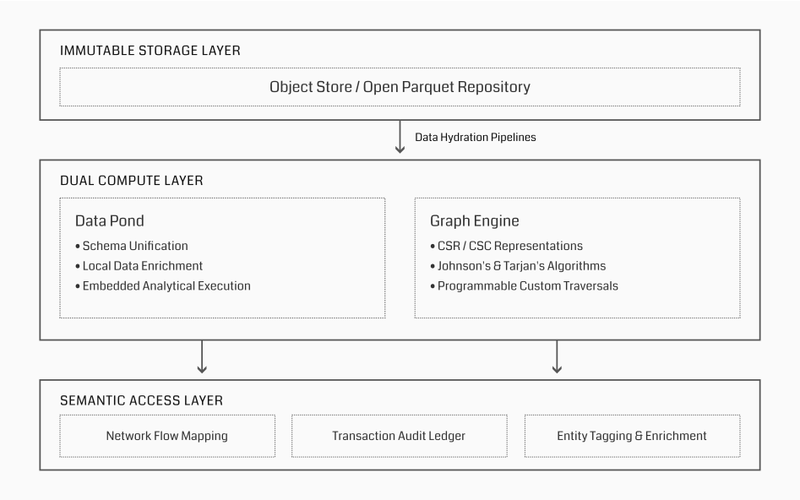
01. The Lakehouse Foundation
The core data lake (S3/Parquet) serves as the immutable storage layer of the lakehouse, providing scalable, open-format records. To enable low-latency querying without blocking active application requests, the system utilizes asynchronous data hydration. The data ponds incrementally pull and sync operational data from the remote S3 lake into a shared, accessible structured data layer.
02. Data Ponds
Rather than querying the entire data lake or using a rigid data warehouse, the system utilizes a specialized Data Pond (a localized, domain-specific, and optimized subset of the lake powered by an embedded DuckDB analytical engine).
- Dynamic Integration: The data pond unifies highly fragmented operational events, dynamically merging disparate intra-network and cross-network feeds into a cohesive relational view at query time.
- Local Data Enrichment: This integrated transaction pond is joined on the fly with localized information tables to provide business context without mutating the underlying lake storage.
03. Graph Engine
To complement our relational data pond, the architecture incorporates a custom graph database engineered for high-performance network analysis.
- CSR/CSC Architecture: The engine leverages memory-mapped Compressed Sparse Row (CSR) and Compressed Sparse Column (CSC) data structures. This enables zero-copy memory access and extreme structural density when modeling massive entity topologies.
- Algorithmic Engine & Traversals: The engine executes specialized graph algorithms—such as Johnson's algorithm for elementary cycle detection and Tarjan's algorithm for strongly connected components, alongside the injection of custom domain logic directly into traversal execution. This enables deep, heuristic tracing of circular routing and complex capital flows that would be unfeasible in standard relational systems.
04. The Semantic Access Layer
The application interface acts as a semantic layer, exposing these dual compute engines through highly specific, domain-oriented access patterns:
- Network Flow Mapping: Extracts node and edge topologies for graph visualization. It applies time filters and groups raw transfers to yield total aggregated volumes and transaction frequency metrics directly from the pond.
- Transaction Audit Ledger: Bypasses aggregation layers to deliver a strict, history of an address's activity, surfacing granular operational attributes.
- Entity Tagging & Enrichment: Facilitates analytical enrichment by accepting manual classification payloads. It inserts these dimensional attributes directly into the local pond's tables, maintaining strict data lineage by permanently stamping the provenance source.